Da: Antinous
/ Antinoo [1918] [1]
.
|
Antinous
|
Antinoo
|
| The
rain outside was cold in Hadrian’s soul. |
La
pioggia fuori era fredda nell'anima d'Adriano. |
The
boy lay dead
On the low
couch, on whose denuded whole,
To Hadrian's
eyes, whose sorrow was a dread,
The shadowy
light of Death's eclipse was shed. |
Il
ragazzo giaceva morto
sul basso divano,
e sul suo corpo denudato,
sugli occhi
di Adriano, il cui dolore era tremendo,
cadeva la luce
ombrosa dell'eclissi della Morte. |
The
boy lay dead, and the day seemed a night
Outside.
The rain fell like a sick affright
Of Nature
at her work in killing him.
Memory of
what he was gave no delight,
Delight
at what he was was dead and dim. |
Il
ragazzo giaceva morto, e il giorno sembrava notte,
fuori. La pioggia
cadeva come un terrore orrendo
della Natura
verso il proprio misfatto d'averlo ucciso.
Il ricordo
di ciò ch'era stato non dava alcun piacere,
e il piacere
di ciò ch'era stato era flebile e morto. |
O
hands that once had clasped Hadrian’s warm hands,
Whose cold
now found them cold!
O hair bound
erstwhile with the pressing bands!
O eyes half-diffidently
bold!
O bare female
male-body such
As a god’s
likeness to humanity!
O lips whose
opening redness erst could touch
Lust's seats
with a live art's variety!
O fingers
skilled in things not to be told!
O tongue
which, counter-tongued, made the blood bold! |
O
mani che un tempo avevano stretto le calde mani d'Adriano,
il cui gelo
ora le trovava gelide!
O capelli un
tempo fermati dai nastri!
O occhi fieri
di semi-diffidente fierezza!
O nudo femminile
corpo di maschio,
di aspetto
divino per la razza umana!
O labbra il
cui rosso dischiuso poteva allora toccare
le sedi di
Lussuria con la varietà di un'arte viva!
O dita esperte
in cose da non dire!
O lingua che,
al tocco d'altra lingua, ringalluzziva il sangue! |
O complete
regency of lust throned on
Raged consciousness's
spilled suspension!
These things
are things that now must be no more.
The rain
is silent, and the Emperor
Sinks by
the couch. His grief is like a rage,
For the
gods take away the life they give
And spoil
the beauty they made live.
He weeps
and knows that every future age
Is looking
on him out of the to-be;
His love
is on a universal stage;
A thousand
unborn eyes weep with his misery. |
O completo
dominio della lussuria, troneggiante al di sopra
della furibonda
razionalità, sospesa e sovvertita!
Queste son
cose che ora non saranno più.
La pioggia
tace, e l'imperatore
sprofonda accanto
al divano. Il suo lutto è quasi furia,
perché
gli dèi tolgono la vita che danno
e guastano
la bellezza che avevano reso viva.
Piange, e sa
che ogni età futura
sta guardando
a lui dal dovrà-essere,
il suo amore
è su un palcoscenico universale;
e mille occhi
non ancora nati piangono la sua pena. |
Antinous
is dead, is dead for ever,
Is dead
for ever and all loves lament.
Venus herself,
that was Adonis' lover,
Seeing him,
that newly lived, now dead again,
Lends her
old grief's renewal to be blent
With Hadrian's
pain. |
Antinoo è
morto, morto è per sempre,
morto è
per sempre e gli amorini gemono.
Venere stessa,
che fu di Adone amante,
vedendolo rinato
in lui, ed ora morto ancora,
lascia che
il rinnovo del suo vecchio lutto si mescoli
al dolore d'Adriano. |
Now is Apollo
sad because the stealer
Of his white
body is for ever cold.
No careful
kisses on that nippled point
Covering
his heart-beats' silent place restore
His life
again to ope his eyes and feel her
Presence
along his veins Love's fortress hold.
No warmth
of his another's warmth demands.
Now will
his hands behind his head no more
Linked,
in that posture giving all but hands,
On the projected
body hands implore. |
Ora Apollo
è triste perché chi gli aveva rubato
il bianco corpo
è per sempre freddo.
Nessun bacio
intento su quel capezzolo appuntito
stampato sul
luogo silenzioso dei suoi battiti riporterà
la vita per
riaprirgli gli occhi e sentirne la
presenza nelle
vene e il possesso della fortezza d'Amore.
Nessun calore
suo richiederà il calore altrui.
Non più
ora le sue mani dietro la testa
allacciate,
in quella posa che tutto offriva meno le mani,
imploreranno
le mani sul corpo disteso. |
The rain
falls, and he lies like one who hath
Forgotten
all the gestures of his love
And lies
awake waiting their hot return.
But all
his arts and toys are now with Death.
This human
ice no way of heat can move;
These ashes
of a fire no flame can burn. |
La pioggia
cade, e lui giace come uno che abbia
dimenticato
tutti i gesti del suo amore
e giaccia sveglio
aspettandone il caldo ritorno.
Ma tutte le
sue arti e i giochi sono ora nella Morte.
Questo gelo
umano non può smuovere alcun calore,
queste ceneri
d'un fuoco non possono alimentare fiamme. |
O Hadrian,
what will now thy cold life be?
What boots
it to be lord of men and might?
His absence
o'er thy visible empery
Comes like
a night,
Nor is there
morn in hopes of new delight.
Now are
thy nights widowed of love and kisses;
Now are
thy days robbed of the night's awaiting;
Now have
thy lips no purpose for thy blisses,
Left but
to speak the name that Death is mating
With solitude
and sorrow and affright. |
O Adriano,
che sarà ora la tua fredda vita?
Che vale
esser padrone d'uomini e potenza?
La sua assenza,
sul tuo visibile imperio,
cala,
come una notte
che
non avrà un mattino con speranze di nuovi piaceri.
Ora
le tue notti sono vedove di amore e baci;
ora
i tuoi giorni sono defraudati dell'attesa della notte;
ora
le tue labbra non servono più alle tuoi estasi, e
possono
solo pronunciare il nome che la Morte sta sposando
a
solitudine, e dolore, e paura. |
|
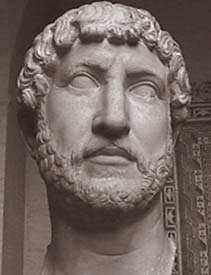
Busto
romano di Adriano (sec. II d.C.).
Monaco,
Glyptotek (foto G. Dall'Orto).
|
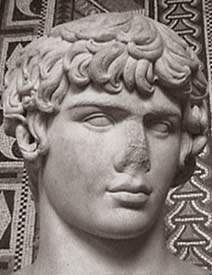
Busto romano
di Antinoo (sec. II d.C.).
Monaco, Glyptotek
(foto G. Dall'Orto). |
Thy vague
hands grope, as if they had dropped joy.
To hear
that the rain ceases lift thy head,
And thy
raised glance take to the lovely boy.
Naked he
lies upon that memoried bed;
By thine
own hand he lies uncoverèd.
There was
he wont thy dangling sense to cloy,
And uncloy
with more cloying, and annoy
With newer
uncloying till thy senses bled. |
Le mani assenti
brancolano, come ne fosse caduta la gioia.
Udire che la
pioggia cessa ti fa sollevare la testa,
e porta il
tuo sguardo alzato al bel ragazzo.
Nudo egli giace
su quel letto di ricordi;
giace scoperto
dalla tua stessa mano.
Lì era
solito stare per saziare i tuoi sensi tesi
e stuzzicarli
con una nuova sazietà, e molestarti
con nuovi stuzzichii,
fino a far sprizzar sangue ai tuoi sensi. |
His hand
and mouth knew games to reinstall
Desire that
thy worn spine was hurt to follow.
Sometimes
it seemed to thee that all was hollow
In sense
in each new straining of sucked lust.
Then still
new turns of toying would he call
To thy nerves'
flesh, and thou wouldst tremble and fall
Back on
thy cushions with thy mind’s sense hushed. |
Mano e bocca
conoscevano giochi per riaccendere
desideri per
cui poi dolorava la tua spina dorsale consunta.
A volte ti
sembrava che tutto fosse vuoto
di senso in
______ _________ lussuria-
Allora lui
chiedeva nuovi giri di schermaglie
alla carne
dei tuoi nervi, e tu tremavi e ricadevi
sui tuoi cuscini
coi sensi della mente ormai placati. |
"Beautiful
was my love, yet melancholy.
He had that
art, that makes love captive wholly,
Of being
slowly sad among lust's rages.
Now the
Nile gave him up, the eternal Nile.
Under his
wet locks Death's blue paleness wages
Now war
upon our wishing with sad smile". |
"Bello era
il mio amore, ma melanconico.
Aveva quell'arte,
che fa sì che amore catturi del tutto,
d'essere lentamente
triste fra frenesie di lussuria.
Ora il Nilo
lo ha _____, l'eterno Nilo.
Sotto i suoi
umidi sigilli il pallore azzurro della morte scatena
ora guerra
ai nostri desideri con un triste sorriso". |
Even as
he thinks, the lust that is no more
Than a memory
of lust revives and takes
His senses
by the hand, his felt flesh wakes,
And all
becomes again what 'twas before.
The dead
body on the bed starts up and lives
And comes
to lie with him, close, closer, and
A creeping
love-wise and invisible hand
At every
body-entrance to his lust
Whispers
caresses which flit off yet just
Remain enough
to bleed his last nerve's strand,
O sweet
and cruel Parthian fugitives! |
Anche mentre
egli pensa, la lussuria che non è più
che un ricordo
di lussuria riavvampa e prende
i suoi sensi
per mano, la sua carne _____ si sveglia,
e tutto torna
ancora quel che è stato prima.
Il corpo morto
sul letto si alza e vive
e va a sdraiarsi
accanto a lui, più vicino, più vicino, e
una mano _____
______ ed invisibile
ad ogni orifizio
corporale alla sua lussuria
sussurra carezze
il cui __ ____ ____
resta abbastanza
da far sanguinare l'ultma fibra deisuoi nervi,
o dolci e crudeli
Parti in fuga! [nota: freccia del Parto] |
So he half
rises, looking on his lover,
That now
can love nothing but what none know.
Vaguely,
half-seeing what he doth behold,
He runs
his cold lips all the body over.
And so ice-senseless
are his lips that, lo!,
He scarce
tastes death from the dead body's cold,
But it seems
both are dead or living both
And love
is still the presence and the mover.
Then his
lips cease on the other lips' cold sloth. |
Così
s'alza a metà, guardando il suo amante,
che ora non
può amare altro che ciò che nessuno sa.
Vagamente,
vedendo solo a metà ciò che egli osserva,
fa scorrere
le labbra fredde su tutto il corpo.
E le sue labbra
sono tanto gelide e insensibili che, ahi!,
gusta a malapena
la morte dal freddo del corpo del morto,
ma sembra che
entrambi siamo morti o entrambi vivi
e amore sia
ancora la presenza ed il motore.
Ma la fredda
indolenza delle labbra altrui ferma le sue labbra. |
Ah, there
the wanting breath reminds his lips
That from
beyond the gods hath moved a mist
Between
him and this boy. His finger-tips,
Still idly
searching o'er the body, list
For some
flesh-response to their waking mood.
But their
love-question is not understood:
The god
is dead whose cult was to be kissed! |
Ah, qui il
respiro assente ricorda alle sue labbra
che da oltre
gli dei una nebbia si è intromessa
fra lui e questo
ragazzo. Le punte delle dita,
che ancora
esplorano svagate il corpo, ____
qualche fremito
carnale al loro gesto di risveglio.
Ma la loro
domanda d'amore non è compresa:
il dio che
si adorava baciandolo, è morto! |
He lifts
his hand up to where heaven should be
And cries
on the mute gods to know his pain.
Let your
calm faces turn aside to his plea,
O granting
powers! He will yield up his reign.
In the still
deserts he will parchèd live,
In the far
barbarous roads beggar or slave,
But to his
arms again the warm boy give!
Forego that
space ye meant to be his grave! |
Solleva le
mani in alto a dove dovrebbe essere il Paradiso
e grida perché
gli dèi muti sappiano il suo dolore.
I vostri visi
sereni si volgano alla sua supplica,
o potenze benigne!
Egli cederà il suo regno.
Nei deserti
silenti inaridito vivrà,
sarà
mendico o schiavo per lontane, barbare strade,
ma ridate ancora
il tiepido ragazzo alle sua braccia!
Rinunciate
allo spazio che volevate fosse la sua tomba! |
Take all
the female loveliness of earth
And in one
mound of death its remnant spill!
But, by
sweet Ganymede, that Jove found worth
And above
Hebe did elect to fill
His cup
at his high feasting, and instil
The friendlier
love that fills the other's dearth,
The clod
of female embraces resolve
To dust,
o father of the gods, but spare
This boy
and his white body and golden hair!
Maybe thy
better Ganymede thou feel'st
That he
should be, and out of jealous care
From Hadrian's
arms to thine his beauty steal'st. |
Prendete tutta
la bellezza femminile della terra
e ___________
_____________ in un ____ di morte!
Ma, per il
dolce Ganimede, che Giove trovò degno
e che preferì
ad Ebe per riempirgli
la coppa ai
festini superni, e instillare
il più
amichevole amore che riempie l'altrui _____,
il ____
di abbracci di donna si riduca
in polvere,
o padre degli dei, ma risparmia
questo ragazzo,
ed il suo bianco corpo, e chiome d'oro!
Forse tu pensi
che un tuo più degno Ganimede
dovrebbe essere,
e per geloso ______
rubi la sua
bellezza dalle braccia d'Adriano alle tue. |
 Eventuale
dida di foto Eventuale
dida di foto
|
He
was a kitten playing with lust, playing
With his
own and with Hadrian's, sometimes one
And sometimes
two, now linking, now undone;
Now leaving
lust, now lust's high lusts delaying;
Now eying
lust not wide, but from askance
Jumping
round on lust's half-unexpectance;
Now softly
gripping, then with fury holding,
Now playfully
playing, now seriously, now lying
By th' side
of lust looking at it, now spying
Which way
to take lust in his lust’s withholding. |
Era
un gattino che giocava con la lussuria, giocando
con la propria
e con quella d'Adriano, a volte uno
e a volte due,
ora legando, ora slacciato;
ora sprigionando
lussuria, ora ritardandone i piaceri [nota c'è
qui gioco di parole su "Lust's high lusts, letteralmente i grandi paiceri
della lussuria]
ora _________
ma di sbieco
___ ________ ____________ __________
ora prendendo
con dolcezza, ora afferrando con furia,
ora giocando
giocosamente, ora seriamente, ora giacendo
al fianco di
lussuria ___________, ora spiando
in che modo
portare lussuria nel suo _______lussurioso. |
Thus
did the hours slide from their tangled hands
And from
their mixed limbs the moments slip.
Now were
his arms dead leaves, now iron bands;
Now were
his lips cups, now the things that sip;
Now were
his eyes too closed and now too looking;
Now were
his uncontinuings frenzy working;
Now were
his arts a feather and now a whip. |
Così
le ore scivolavano dalle loro mani intrecciate
e dalle loro
membra confuse i momenti scivolavano.
Ora le braccia
erano foglie morte, ora fasce d'acciaio;
ora le labbra
erano coppe, ora ciò che sorseggia;
ora gli occhi
troppo chiusi ed ora troppi fissi;
ora ______________________________
ora le sue
arti erano una piuma ed ora una frusta. |
That
love they lived as a religion
Offered
to gods that come themselves to men.
Sometimes
he was adorned or made to don
Half-vestures,
then in statued nudity
Did imitate
some god that seems to be
By marble's
accurate virtue men's again.
Now was
he Venus, white out of the seas;
And now
was he Apollo, young and golden;
Now as Jove
sate he in mock judgement over
The presence
at his feet of his slaved lover;
Now was
he an acted rite, by one beholden,
In ever-repositioned
mysteries. |
L'amore
che vissero come una religione
l'offrirono
a dèi che vengono essi stessi agli uomini.
Talora era
_______ e fatto per ___
semisvestito,
ora in statuaria nudità
imitava qualche
dio che sembra essere,
per l'accurata
virtù del marmo, di nuovo uomo.
Ora egli era
Venere, bianca e sorgente dalle acque;
ed ora egli
era Apollo, giovane e dorato;
ora come Giove
sedeva in scherzoso processo
alla presenza,
ai suoi piedi, del suo amante schiavizzato;
ora era un
rito_______, da uno ______,
in Misteri
mai _________. |
Now
he is something anyone can be.
O stark
negation of the thing it is!
O golden-haired
moon-cold loveliness!
Too cold!
too cold! and love as cold as he!
Love through
the memories of his love doth roam
As through
a labyrinth, in sad madness glad,
And now
calls on his name and bids him come,
And now
is smiling at his imaged coming
That is
i'th' heart like faces in the gloaming –
Mere shining
shadows of the forms they had. |
Ora
è qualcosa che chiunque può essere.
O negazione
___ della cosa che è!
O bellezza
freddamente lunare dalle chiome d'oro!
Troppo fredda!
Troppo fredda! E amore freddo quanto lui!
L'amore _____
attraverso i ricordi del suo amore
come attraverso
un labirinto, lieto nella triste follia.
ed ora chiama
il suo nome e lo prega di venire,
ed ora sta
sorridendo alla sua immagine che viene
che è
nel cuore come facce nel _________
mere ombre
splendenti delle forme che furono. |
The
rain again like a vague pain arose
And put
the sense of wetness in the air.
Suddenly
did the Emperor suppose
He saw this
room and all in it from far.
He saw the
couch, the boy, and his own frame
Cast down
against the couch, and he became
A clearer
presence to himself, and said
These words
unuttered, save to his soul’s dread: |
La
pioggia riprese ancora, come un dolore tenue,
aggiungendo
nell'aria un sentore d'umido.
All'improvviso
all'imperatore parve
d'aver visto
la stanza e quanto conteneva, da lontano.
Vide il divano,
il ragazzo, e la sua stessa forma
gettata sul
divano, e divenne così
una presenza
più chiara a se stesso, e disse
queste parole
non dette, salvo che al ____ della sua anima: |
"I shall
build thee a statue that will be
To the continued
future evidence
Of my love
and thy beauty and the sense
That beauty
giveth of divinity.
Though death
with subtle uncovering hands remove
The apparel
of life and empire from our love,
Yet its
nude statue, that thou dost inspirit,
All future
times, whether they will’t or not,
Shall, like
a gift a forcing god hath brought,
Inevitably
inherit. |
"T'innalzerò
una statua che sarà
per il futuro
a venire una prova
del mio amore
e della tua bellezza e del senso
di divinità
che la bellezza dà.
Benché
la morte con mani sottili e scoprenti tolga
l'_____
di vita e potere al nostro amore,
questa nuda
statua, che tu ispiri,
tutti i tempi
a venire, che lo vogliano o meno
dovranno, quasi
dono portato a forza da un dio,
inevitabilmente
ereditare. |
"Ay, this
thy statue shall I build, and set
Upon the
pinnacle of being thine, that Time
By its subtle
dim crime
Will fear
to eat it from life, or to fret
With war’s
or envy’s rage from bulk and stone.
Fate cannot
be that! Gods themselves, that make
Things change,
Fate’s own hand, that doth overtake
The gods
themselves with darkness, will draw back
From marring
thus thy statue and my boon,
Leaving
the wide world hollow with thy lack". |
"Ahi, questa
tua statua erigerò, e la porrò
sulla cima
del fatto d'esser tuo, che il Tempo
col suo crimine
sottile e ________
avrà
paura a mangiar via dalla vita, o a ____
con rabbia
di guerra o gelosia, da _____ e pietra.
Ma il destino
non può esser questo! Gli stessi dèi, che fan
cambiar le
cose, la mano stessa del Destino, che sommerge
gli stessi
dèi con l'oscurità, si tratterrà
dal ________
così la tua statua e la mia _____
lasciando il
vasto mondo vuoto per la tua assenza. |
"This picture
of our love will bridge the ages.
It will
loom white out of the past and be
Eternal,
like a Roman victory,
In every
heart the future will give rages
Of not being
our love’s contemporary". |
"Quest'immagine
del nostro amore scavalcherà le epoche.
______rà
candida dal passato e sarà
eterna, come
una vittoria romana,
ad ogni cuore
del futuro farà rabbia il fatto
di non essere
contemporaneo al nostro amore". |
"Yet oh
that this were needed not, and thou
Wert the
red flower perfuming my life,
The garland
on the brows of my delight,
The living
flame on altars of my soul!
Would all
this were a thing thou mightest now
Smile at
from under thy death-mocking lids
And wonder
that I should so put a strife
Twixt me
and gods for thy lost presence bright;
Were there
nought in this but my empty dole
And thy
awakening smile half to condole
With what
my dreaming pain to hope forbids". |
"Ah, se solo
di tutto questo non ci fosse bisogno, e tu
fossi il fiore
scarlatto che mi profuma la vita,
la ______
sugli _______del mio piacere,
la fiamma viva
sugli altari della mia anima!
Oh, se tutto
questo fosse un cosa di cui potessi ora
sorridere da
sotto le tue palpebre, irridenti la morte,
e meravigliarti
che io possa così _________
tra me e gli
dèi per la tua perduta _____ presenza:
_______
_______ in ciò se non il mio vuoto
____
e il tuo sorriso
________ e metà per condolerti
di ciò
che il dolore proibisce ai miei sogni di sperare". |
Thus went
he, like a lover who is waiting,
From place
to place in this dim doubting mind.
Now was
his hope a great intention fating
Its wish
to being, now felt he he was blind
In some
point of his seen wish undefined. |
Così
egli andò, come amante che aspetta,
di luogo in
luogo in questo stato d'animo ___
dubbioso.
Ora la sua
speranza era una grande _____ ____
la sua speranza
d'essere, ora sentiva d'essere cieco,
a qualche punto
del suo indefinito desiderio ____. |
When love
meets death we know not what to feel.
When death
foils love we know not what to know.
Now did
his doubt hope, now did his hope doubt;
Now what
his wish dreamed the dream’s sense did flout
And to a
sullen emptiness congeal.
Then again
the gods fanned love’s darkening glow. |
Quando Amore
incontra Morte non sappiamo che provare.
Quando la morte
______ noi non sappiamo cosa sapere.
Ora il suo
dubbio sperava, ora la sua speranza dubitava;
ora quel che
il desiderio speravo il senso del sogno lo _____
e lo ________
ad una _________ vuotezza.
E poi di nuovo
gli dei riattizzavano il ___________dell'amore |
![Paul Avril, Scena di sesso fra Adriano ed Antinoo [1906]](antinoo1906.jpg)
|
|
Paul Avril,
"Adriano e Antinoo in Egitto" (dettaglio) [1906], da: Manuel d'érotologie
classique (collezione e cortesia Raimondo Biffi).
Ho censurato l'immagine per non offendere la sensibilità di nessuno.
|
"Thy
death has given me a higher lust –
A flash-lust
raging for eternity.
On mine
imperial fate I set my trust
That the
high gods, that made me emperor be,
Will not
annul from a more real life
My wish
that thou should’st live for e'er and stand
A fleshly
presence on their better land,
More lovely
yet not lovelier, for there
No things
impossible our wishes mar
Nor pain
our hearts with change and time and strife". |
"La
tua morte m'ha dato una brama più alto;
una brama-lampo________
per l'eternità.
Sul mio fato
imperiale io _____ il mio ______
che gli alti
dei, che han fatto sì che fossi imperatore,
non annulleranno
da una più reale vita,
il mio voto
che tu viva per sempre e che tollerino
una presenza
corporea nel loro mondo migliore,
più
amabile ma non più bello,
perché lassù
nessuna ____impossibile
____ i nostri desideri,
né il
dolore i nostri cuori con cambiamento, e tempo e ____". |
"Love,
love, my love! thou art already a god.
This thought
of mine, which I a wish believe,
Is no wish,
but a sight, to me allowed
By the great
gods, that love love and can give
To mortal
hearts, under the shape of wishes –
Of wishes
having undiscovered reaches –,
A vision
of the real things beyond
Our life-imprisoned
life, our sense-bound sense.
Ay, what
I wish thee to be thou art now
Already.
Already on Olympic ground
Thou walkest
and art perfect, yet art thou,
For thou
needst no excess of thee to don
Perfect
to be, being perfection". |
"Amore,
amore, mio amore! Tu sei già un dio.
Questo mio
pensiero, che credo un desiderio,
non è
un desiderio, ma una visione, concessami
dai grandi
dèi, che amano l'amore e possono darlo
a cuori mortali,
sotto forma di desideri -
di desideri
dalle __________ mai scoperte -
una visione
delle realtà al di là della
nostra vita
imprigionata dalla vita, del senso legato al senso.
Ahi, quel che
avrei voluto tu fossi tu ora lo sei
già.
Già sul suolo dell'Olimpo
tu incedi e
sei perfetto, eppure sei tu,
perché
tu non hai bisogno di ____ un eccesso di te
per essere
perfetto, essendo tu la Perfezione". |
"My
heart is singing like a morning bird.
A great
hope from the gods comes down to me
And bids
my heart to subtler sense be stirred
And think
not that strange evil of thee
That to
think thee mortal would be". |
"Il
mio cuore canta come un uccello al mattino.
Una speranza
grande scende dagli dèi a me
e ____
il mio cuore ad essere ____ a senso più
sottile
e a non pensare
di te quello strano male
che sarebbe
il pensarti mortale". |
"My
love, my love, my god-love! Let me kiss
On thy cold
lips thy hot lips now immortal,
Greeting
thee at Death's portal's happiness,
For to the
gods Death's portal is Life's portal". |
"Amore
mio, amore mio, dio-amore mio! Permettimi un bacio
sulle tue fredde
labbra alle tue labbra ardenti ora immortali,
augurandoti
felicità sulla porta della Morte,
perché
per gli dèi la porta della Morte è la porta della Vita". |
"Were
no Olympus yet for thee, my love
Would make
thee one, where thou sole god mightst prove,
And I thy
sole adorer, glad to be
Thy sole
adorer through infinity.
That were
a universe divine enough
For love
and me and what to me thou art.
To have
thee is a thing made of gods' stuff
And to look
on thee eternity's best part". |
"Se
non ci fosse un Olimpo per te, il mio amore
te ne farebbe
uno, dove saresti l'unico dio
ed io il tuo
solo adoratore, felice d'essere
il tuo solo
adoratore per l'eternità.
Quello sarebbe
un universo abbastanza divino
per l'amore
e me e ciò che per me sei tu.
L'avere te
è cosa fatta d'essenza divina
e guardar te
è la parte migliore dell'eternità". |
"But this
is true and mine own art: the god
Thou art
now is a body made by me,
For, if
thou art now flesh reality
Beyond where
men age and night cometh still,
'Tis to
my love's great making power thou owest
That life
thou on thy memory bestowest
And mak'st
it carnal. Had my love not held
An empire
of my mighty legioned will,
Thou to
gods' consort hadst not been compelled". |
"Ma questa
è l'arte vera e mia soltanto: il dio
che sei ora
è un corpo fatto da me,
perché,
se tu sei ora realtà di carne
oltre quella
in cui gli uomini invecchiano e la notte arriva,
è al
grande potere creativo del mio amore che tu devi
quella vita
che conferisci alla tua memoria
e la rende
carnale. Se il mio amore non avesse retto
un imperio
sul mio volere fondato su possenti legioni,
tu non saresti
stato imposto alla compagnia degli dèi". |
"My love
that found thee, when it found thee did
But find
its own true body and exact look.
Therefore
when now thy memory I bid
Become a
god where gods are, I but move
To death’s
high column’s top the shape it took
And set
it there for vision of all love. |
"L'amore mio
che t'ha trovato, quando l'ha fatto ha solo
trovato il
proprio corpo vero e aspetto esatto.
Pertanto quando
ora la tua memoria _____
divieni un
dio dove stanno gli dèi, muovo soltanto
sopra l'alta
colonna della morte la forma che essa ha preso
e la colloco
là per visione di ogni amore. |
"O love,
my love, put up with my strong will
Of loving
to Olympus, be thou there
The latest
god whose honey-coloured hair
Takes divine
eyes! As thou wert on earth, still
In heaven
bodyfully be and roam,
A prisoner
of that happiness of home,
With elder
gods, while I on earth do make
A statue
for thy deathlessness’ seen sake". |
"O amore, mio
amore, ______ col mio fermo volere
di amare all'Olimpo,
sii tu lassù
l'ultimo dio,
i cui capelli color miele
attraggono
occhi divini! Com'eri sulla terra,
così
in paradiso sii ______ e _____,
prigioniero
di quella felicità di casa,
con dèi
più anziani, mentre sulla terra io farò
una statua
per la tua ________ immortale". |
"Yet thy
true deadless statue I shall build
Will be
no stone thing, but that same regret
By which
our love’s eternity is willed.
One side
of that is thou, as gods see thee
Now, and
the other, here, thy memory.
My sorrow
will make that men's god, and set
Thy naked
memory on the parapet
That looks
upon the seas of future times.
Some will
say all our love was but our crimes;
Others against
our names the knives will whet
Of their
glad hate of beauty’s beauty, and make
Our names
a base of heap whereon to rake
The names
of all our brothers with quick scorn.
Yet will
our presence, like eternal Morn,
Ever return
at Beauty’s hour, and shine
Out of the
East of Love, in light to enshrine
New gods
to come, the lacking world to adorn". |
"Eppure la
tua statua davvero immortale innalzerò:
non sarà
un oggetto di pietra, ma del rimpianto stesso
a cui è
affidata l'eternità del nostro amore.
Un aspetto
di essa è te, come gli dei vedono
adesso te,
e l'altro, qui, il ricordo di te.
Il mio dolore
creerà quel dio per gli uomini, e porrà
la tua nuda
memoria sul parapetto
che
spazia verso i mari dei tempi a venire.
Qualcuno
dirà che l'amore nostro era solo delitti;
altri
contro i nostri nomi affilerà i coltelli
del
loro lieto odio della bellezza del bello, e faranno
dei
nostri nomi la base d'una pila su cui rastrellare
con
facile scherno i nomi dei nostri fratelli tutti.
Ma
con la nostra presenza, come un Lutto eterno,
sempre
ritorna all'ora
della bellezza, e splendi
dal
Levante d'Amore, per ________
di luce
nuove
divinità a venire, adornandone il mondo orbato". |
"All that
thou art now is thyself and I.
Our dual
presence has its unity
In that
perfection of body which my love,
By loving
it, became, and did from life
Raise into
godness, calm above the strife
Of times,
and changing passions far above". |
"Tutto ciò
che sei tu adesso è te stesso e me.
La nostra presenza
duale ha la sua unità
in quella perfezione
del corpo che il mio amore,
amandola, diventò,
e dalla vita s'è innalzata
a stato divino,
calma sopra la ______
dei tempi,
ben al sopra delle mutevoli passioni". |
"But since
men see more with the eyes than soul,
Still I
in stone shall utter this great dole;
Still, eager
that men hunger by thy presence,
I shall
to marble carry this regret
That in
my heart like a great star is set.
Thus, even
in stone, our love shall stand so great
In thy statue
of us, like a god's fate,
Our love's
incarnate and discarnate essence,
That, like
a trumpet reaching over seas
And going
from continent to continent,
Our love
shall speak its joy and woe, death-blent,
Over infinities
and eternities". |
"Ma poiché
gli uomini vedono più con l'occhio che con l'anima
allora io ____rò
in pietra questo grande _____;
allora, _____
che gli uomini sentano fame della tua presenza,
trasfonderò
nel marmo il mio rimpianto
stabilitosi
nel mio cuore come una grande stella.
Così,
anche nella pietra, il nostro amore sarà tanto grande,
nella tua statua
di noi, come il fato d'un dio,
l'essenza incarnata
e disincarnata del nostro amore,
che, come un
araldo____ sopra
i mari
vagando di
continente in continete,
il nostro amore
dirà di gioia e di dolore, ____dalla
morte,
sopra le infinità
e le eternità". |
"And here,
memory or statue, we shall stand,
Still the
same one, as we were hand in hand
Nor felt
each other’s hand for feeling feeling.
Men still
will see me when thy sense they take.
The entire
gods might pass in the vast wheeling
Of the globed
ages. If but for thy sake,
That, being
theirs, hadst gone with their gone band,
They would
return, as they had slept to wake". |
"E qui, memoria
o statua, qui noi staremo,
ancora la stessa
cosa sola che eravamo, mano nella mano,
non percependo
la mano dell'altro per il sentimento provato.
Gli uomini
vedranno ancora me quando _____________
Gli dèi
per intero potrebbero trapassare, nella vasta ruota
delle sferiche
ere. Non fosse altro per il solo merito di te,
che, essendo
loro, sei andato con la loro schiera andata,
essi tornerebbero,
come se avessero dormito per svegliarsi". |
"Then the
end of days when Jove were born again
And Ganymede
again pour at his feast
Would see
our dual soul from death released
And recreated
unto joy, fear, pain –
All that
love doth contain;
Life – all
the beauty that doth make a lust
Of love's
own true love, at the spell amazed;
And, if
our very memory wore to dust,
By some
gods' race of the end of ages must
Our dual
unity again be raised". |
"Poi alla fine
dei giorni, quando Giove fosse rinato
e Ganimede
di nuovo mescesse ai suoi banchetti,
vedrebbero
la nostra anima duale liberata dalla morte
e ricreata
come gioia, paura, dolore -
tutto ciò
che l'amore contiene;
la vita, tutta
la bellezza che rende una lussuria
vero amore
dello stesso amore, all'incantesimo ________:
e,
se la memoria stessa di noi fosse consunta e impolverita,
da
qualche razza di dèi della fine dei tempi dovrà
la nostra unità
duale esser resuscitata". |
It rained
still. But slow-treading night came in,
Closing
the weary eyelids of each sense.
The very
consciousness of self and soul
Grew, like
a landscape through dim raining, dim.
The Emperor
lay still, so still that now
He half
forgot where now he lay, or whence
The sorrow
that was still salt on his lips.
All had
been something very far, a scroll
Rolled up.
The things he felt were like the rim
That haloes
round the moon when the night weeps. |
Pioveva ancora.
Ma a passo lento la notte entrò,
chiudendo le
palpebre esauste di ogni senso.
La coscienza
stessa del sé e dell'anima
crebbe, come
fosco paesaggio attraverso pioggia fosca.
L'imperatore
giace immobile, immobile tanto che ora
ha mezzo scordato
dove ora giaccia, o da dove
il dolore che
era sale ___ sulle sue labbra.
Tutto era stato
qualcosa di molto lontano, un rotolo
riavvolto.
Le cose percepite erano come l'alone
che aleggia
attorno alla luna quando la notte piange. |
His head
was bowed into his arms, and they
On the low
couch, foreign to his sense, lay.
His closed
eyes seemed open to him, and seeing
The naked
floor, dark, cold, sad and unmeaning.
His hurting
breath was all his sense could know.
Out of the
falling darkness the wind rose
And fell;
a voice swooned in the courts below;
And the
Emperor slept. |
La testa era
chinata nelle braccia, che
sul divano
basso, estranee ai suoi sensi, giacevano.
I suoi occhi
chiusi sembravano aperti a lui, e vedenti
il nudo pavimento,
scuro, freddo, triste ed insignificante.
Il suo doloroso
respiro era tutto ciò che i sensi percepivano.
Dall'oscurita
che scendeva sorse il vento
e cadde; una
voce si smorzò nei cortili al di sotto;
e l'imperatore
dormì. |
The gods came now
And bore
something away, no sense knows how,
On unseen
arms of power and repose. |
Gli dèi vennero adesso
e portarono
via qualcosa, nessun senso umano sa come,
su braccia
invisibili di forza e riposo |
[2].
[3].
[4].
[5].
[6].
[7].
[8].
[9].
[10].
[11].
[12].
L'autore ringrazia
fin d'ora chi vorrà aiutarlo a trovare immagini e ulteriori dati
su persone, luoghi e fatti descritti in questa pagina, e chi gli segnalerà
eventuali errori in essa contenuti. |
Note
[1]
Il testo dal sito: Androphile.
Pessoa visse
per quasi un decennio in Sudafrica, dove l'inglese divenne la sua prima
lingua, e quindi poté scrivere questa poesia (molto lunga) direttamente
in inglese. L'opera pullula di termini che i dizionari che
ho consultato definiscono "obsoleti"
Il testo descrive
il dolore dell'imperatore romano Adriano
per la morte di Antinoo.
Su quest'opera
si veda il capitolo: "La questione sessuale: Antinoo
ed Epitalamio" in: La vita plurale di Fernando Pessoa
di Ángel Crespo (online
in formato .pdf).
Sull'omosessualità
nella poesia di Pessoa, si veda nel presente sito l'antologia
di poesie di Álvaro de Campos, e la esplicita poesia
"Saluto
a Walt Whitman".
"Antinoo"
è stata tradotta in italiano nell'antologia: Fernando
Pessoa, Una sola moltitudine, vol. 2, Adelphi, Milano 2006, pp.186-205.
Anche
come: Fernando
Pessoa, Poemetti erotici: Epitalamio-Antinoo, Passigli, Firenze
2007.
[2].
[3].
[4].
[5].
[6].
[7].
[8].
[9].
[10].
[11].
[12]. |